

IAS 28 Amendment: When Can an Investment in an Associate or Joint Venture Be Measured at Fair Value?
The short answer
The amendment issued in June 2026 does not remove the equity method, nor does it make the fair value option available to every entity with an investment in an associate or joint venture. It clarifies, in a targeted way, which entities might be eligible to elect to measure certain such investments at fair value through profit or loss under IFRS 9 instead of applying the equity method. [1] [2]
The practical message: Holding 20% or more, or having significant influence, does not by itself create a fair value option. The reporting entity’s nature, its main business activity, the timing of the election, and the IFRS 18 transition requirements must first be assessed.
Why does this amendment matter?
An entity can hold an interest in another company without controlling it. If it can participate in that company’s financial and operating policy decisions without controlling or jointly controlling those policies, that company can be an associate. If parties have joint control and rights to the arrangement’s net assets, the arrangement can be a joint venture. In both cases, the equity method is normally the accounting starting point. [3]
Different interpretations had developed around the phrase “similar entities” in the IAS 28 exception for the fair value option. The issue became more important as IFRS 18 introduced new requirements for classifying income and expenses in the statement of profit or loss. The IASB therefore issued a narrow-scope amendment to clarify the eligible population without changing the standard’s general rule. [1]
Four ideas before the detail
| Term | Practical meaning |
|---|---|
| Associate | An entity over which an investor has significant influence, but not control or joint control. Holding 20% or more of voting power creates a presumption of significant influence, not an automatic conclusion in every case. [3] |
| Joint venture | A joint arrangement in which parties with joint control have rights to the arrangement’s net assets. [3] |
| Equity method | The investment begins at cost. Its carrying amount is then adjusted for the investor’s share of the investee’s subsequent profit or loss, while distributions reduce the carrying amount. [3] |
| Fair value through profit or loss | Measurement under IFRS 9 in which fair value changes are recognised in profit or loss, if the entity is eligible and elects the limited IAS 28 exception. [2] |
What changed, precisely?
The final issuance amended IAS 28 paragraphs 18–19 and added paragraph 45M. It clarifies that “similar entities” include entities whose main business activity is investing in particular types of assets, by reference to IFRS 18 paragraph 49(a). [2]
This clarification concerns an exception to the equity method. It does not turn the exception into a general rule. The election is made separately for each associate or joint venture at initial recognition; it is not a broad policy decision made simply because management prefers a different presentation of results. [2]
What did not change?
IAS 28 continues to require the equity method for investments in associates and joint ventures in the ordinary case, subject to the standard’s stated exceptions. The amendment does not say that every operating company with a significant-influence investment can move to fair value through profit or loss. The IASB considered a broader option, but kept this amendment targeted to the identified interpretive issue. [1] [4]
Important caution: Calling an entity “investment-focused” in a commercial or marketing sense is not enough. The accounting assessment requires analysis of the entity’s main business activity, facts, contracts, and applied accounting policies.
A simple accounting decision path
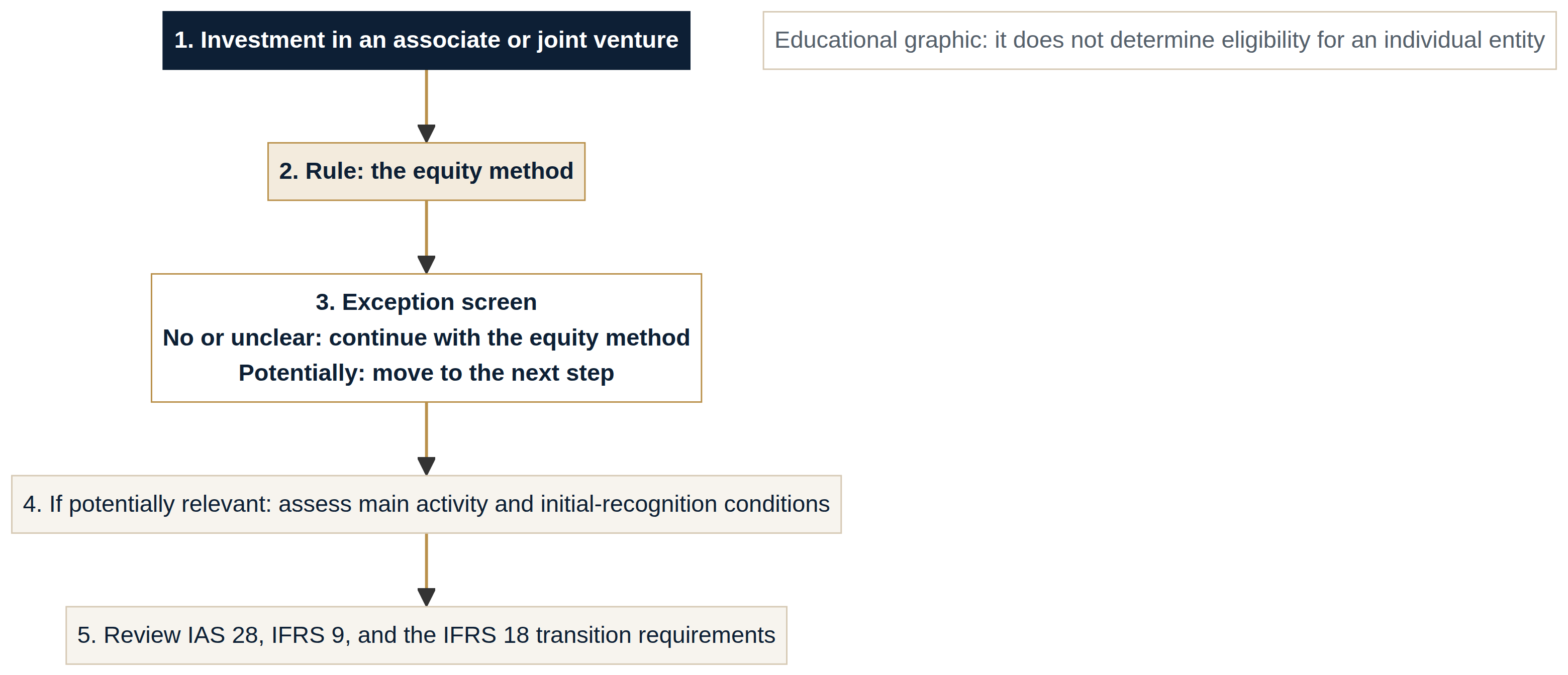
Educational graphic: the equity method is the starting point; the fair value option is assessed only within the limited exception and for the relevant investment.
A simplified educational example
Consider two independent scenarios:
| Scenario | Initial question to assess |
|---|---|
| An operating company owns 25% of another company and participates in its decisions. | Significant influence may lead to the equity method. A fair value option does not arise automatically merely because the company holds an investment or because fair value appears more useful to management. |
| An entity’s main business activity is investing in particular types of assets and it invests in an associate. | The entity should assess whether it falls within the post-amendment “similar entities” scope, and whether the fair value election is available for that specific investment at initial recognition, consistently with IFRS 18 and IFRS 9. |
This example does not determine eligibility for any individual entity. Group structure, the nature of the business, the investment acquisition date, existing policies, and disclosure requirements can all matter in a real assessment.
When does it apply?
The IASB states that the amendments take effect when an entity first applies IFRS 18. IFRS 18 is effective for annual reporting periods beginning on or after 1 January 2027. New IAS 28 paragraph 45M requires the amendments to be applied in accordance with IFRS 18 paragraph C7 and also addresses an entity that elected earlier application of IFRS 18. [1] [2]
In Saudi Arabia, entities should follow the Saudi Organization for Chartered and Professional Accountants’ adopted editions and subsequent updates, while assessing the amendment against their own facts before adopting a policy, journal entry, or disclosure. SOCPA explains that its 2026 Arabic edition reflects standards adopted as at 1 January 2026, with later updates published on its website. [5]
A practical checklist for management and finance teams
Before changing any accounting treatment, start with these questions:
- Does the investment meet the definition of an associate or a joint venture?
- What is the reporting entity’s main business activity, and what evidence supports that conclusion?
- Does the investment, or the portion held, fall within the amended exception’s scope?
- When was the investment initially recognised, and are the IFRS 18 transition provisions relevant?
- What would be the effect on measurement, profit or loss presentation, and disclosures?
- Have the locally adopted text and the entity-specific facts been reviewed by a qualified accounting team?
Closing perspective
This amendment is not an invitation to replace the equity method broadly. It is a clarification for a focused situation: entities whose main business activity is investing in particular types of assets and which may fall within the IAS 28 “similar entities” scope. Its value lies in reducing interpretive diversity before IFRS 18 is applied, not in granting every investor a new measurement choice. [1] [2]
For an entity with investments in associates or joint ventures, the better question is not “Can we choose fair value?” but “Do the conditions for the option apply to us at all, and what would the reporting and disclosure consequences be?”
Related service: Financial Advisory
Talk to an Expert: Start a conversation
Sources and references
[1] IFRS Foundation — IASB issues amendments clarifying the fair value option in IAS 28, 26 June 2026
[3] IFRS Foundation — IAS 28 Investments in Associates and Joint Ventures
[4] IFRS Foundation — Amendments to the Fair Value Option (IAS 28): completed project
[5] SOCPA — الهيئة تصدر النسخة العربية المحدثة للمعايير الدولية للتقرير المالي لعام 2026م