

Unpaid Capital Under the IFRS for SMEs Accounting Standard
An entity applying the IFRS for SMEs Accounting Standard may issue equity instruments while full consideration has not yet been collected at the reporting date. The issue is not limited to whether the counterparty remains obliged to pay. The accounting question is how the unpaid amount should be classified: as a current asset, or as a deduction from equity?
Scope of this article: This explanation is limited to entities applying the IFRS for SMEs Accounting Standard. It does not address the selection of legal form or incorporation procedures. The technical conditions are that equity instruments have been issued and the consideration due for them is enforceable.
Professional conclusion
When equity instruments have already been issued and the other party is obliged to provide cash or other resources in exchange, the issued capital is recognised in equity and the unpaid amount is presented as an offset against equity in the statement of financial position, not as an asset, unless local law or regulation prohibits that presentation.[1] [2]
SOCPA’s published response to Inquiry No. 178 states that, at the time of its response, there was no Saudi legal or regulatory requirement that required or prohibited a different presentation. Applying the Section 22 treatment was therefore appropriate.[1]
Key outcome: The two commonly circulated presentations are not equally acceptable under SOCPA’s response. Presenting unpaid capital as a current receivable or other asset is inconsistent with Section 22.7. The appropriate presentation is as an offset against equity.
| Common presentation | Assessment under SOCPA’s response |
|---|---|
| Recognise full capital and show unpaid capital as a shareholder receivable or current asset | Not aligned with Section 22.7, because the receivable is presented against equity rather than as an asset. |
| Recognise issued capital and deduct unpaid capital within equity | Appropriate where equity instruments have been issued and the consideration is enforceable, subject to any specific legal or regulatory requirement. |
What does paragraph 22.7 require?
Paragraph 22.7 separates three circumstances that should not be confused:[2]
| Circumstance | Accounting treatment |
|---|---|
| Equity instruments have been issued before cash is received and the consideration is enforceable | Recognise equity and present the receivable as an offset against equity, not as an asset. |
| Cash or other resources are received before shares are issued and the company cannot be required to repay them | Recognise the corresponding increase in equity to the extent received. |
| Shares have been subscribed for but not issued, and no cash or other resources have been received | Do not recognise an increase in equity at that point. |
Subscription is not the same as issuance. Before recording the entry, the accountant should examine the issuance documents, evidence that consideration is enforceable, and records supporting the amounts collected.
What about entities applying full IFRS Accounting Standards?
SOCPA explained that full IFRS Accounting Standards do not contain a similarly detailed rule for this fact pattern. However, IAS 32 generally requires transactions in an entity’s own equity instruments to be recognised directly in equity. By applying the policy-selection hierarchy in IAS 8, SOCPA concluded that using the IFRS for SMEs treatment is appropriate because it does not conflict with full IFRS requirements or the Conceptual Framework.[1]
Illustrative example
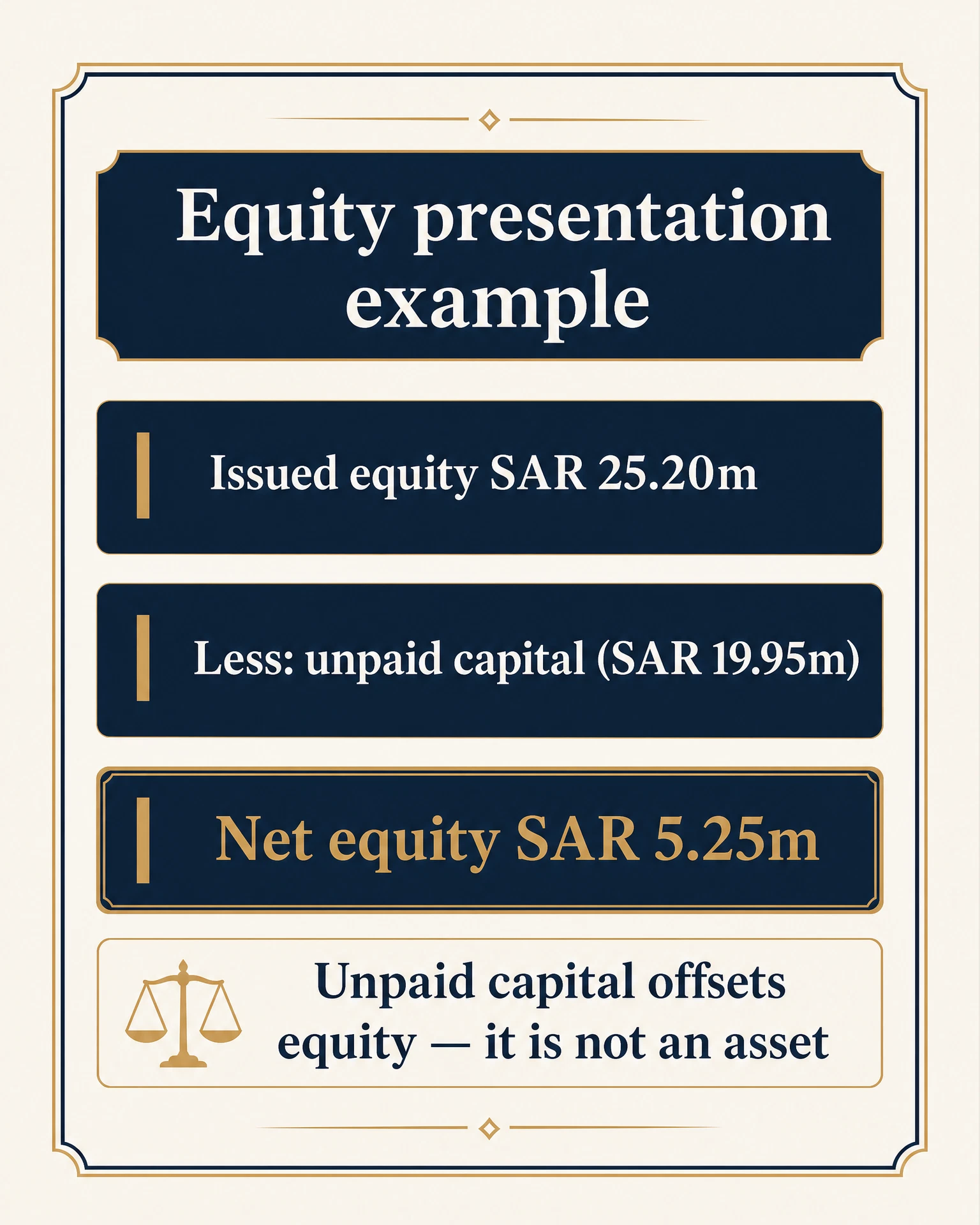 Assume an entity applying the IFRS for SMEs Accounting Standard has issued equity instruments and has the following capital information:
| Item | SAR million |
|---|---|
| Issued share capital | 25.20 |
| Consideration collected | 5.25 |
| Unpaid amount | 19.95 |
If equity instruments have been issued and the consideration is enforceable, equity may be presented as follows:
| Equity presentation | SAR million |
|---|---|
| Issued share capital | 25.20 |
| Less: unpaid share capital | (19.95) |
| Net amount reflected within equity | 5.25 |
Illustratively, on issuance the entity may debit an unpaid capital / contra-equity account and credit issued equity capital. When cash is received, it debits cash and credits the contra-equity account. Account titles may vary with the chart of accounts, but the unpaid amount does not become a current asset simply because the consideration is enforceable.
A note on the third edition of the Standard
SOCPA approved the third edition of the IFRS for SMEs Accounting Standard for application in Saudi Arabia, permitting early adoption and subject to Saudi endorsement modifications.[3] Internationally, the third edition applies to annual periods beginning on or after 1 January 2027, with early application permitted.[2]
The third edition retains the core treatment and adds an explicit clarification: if local law or regulation prohibits presentation of the receivable as an offset against equity, the entity follows the presentation required by that law or regulation. At the date of its response, SOCPA had not identified a Saudi requirement mandating or prohibiting a specific presentation.[1]
What should be checked before posting the entry?
The accounting team should confirm that the equity instruments were actually issued, not merely subscribed for; confirm that the consideration is enforceable; reconcile issued and collected amounts to issuance documents and supporting records; and disclose issued instruments together with collected and uncollected consideration clearly.
The accounting presentation must also be kept separate from zakat treatment. Presentation in the statement of financial position does not by itself determine the zakat treatment, which requires a separate assessment under applicable zakat rules and the entity’s facts.
Entities subject to sector-specific regulation should also consider relevant regulatory requirements before finalising their presentation.
Conclusion
Unpaid capital from equity instruments that have already been issued is not presented as a current asset under the treatment described above. It is presented as an offset against equity against issued capital. The obligation to pay remains enforceable, but it is distinct from financial-statement classification.
For the official response and supporting details, refer to SOCPA’s page on the presentation of unpaid share capital.[1]
Do you face a similar issue while preparing financial statements?
Talk to an AMK expert to review the issuance documents, reconcile issued and paid capital, and determine appropriate presentation and disclosure under the applicable reporting framework.